3 ways corporate travel booking breaks down after the reservation
Corporate booking tools may handle the initial reservation well, but trip changes and disruptions expose a different set of demands. New research from Christopherson shows where the managed booking experience is breaking down and what travel programs should expect from booking technology after confirmation.
August 28, 2026
Corporate travel booking has traditionally focused on getting the traveler from search to confirmation. But completing the reservation is only the first test of a booking tool.
Business trips change. Flights are delayed. Meetings move. Hotel stays need to be extended. A traveler who booked through an approved channel may suddenly need a fast alternative or help from an advisor.
New Christopherson research suggests that these post-booking moments expose some of the biggest weaknesses in today’s corporate travel booking environment. Based on a survey of 123 U.S. professionals in travel management, procurement, operations, and finance, only 20% of respondents said their current booking tools support their organization’s travel needs “very effectively.”
The findings point to three areas travel managers should pay particular attention to when evaluating the booking experience.
1. Travelers struggle with self-service once a trip needs to change
Business travel programs need to plan for changes as part of the normal trip lifecycle.
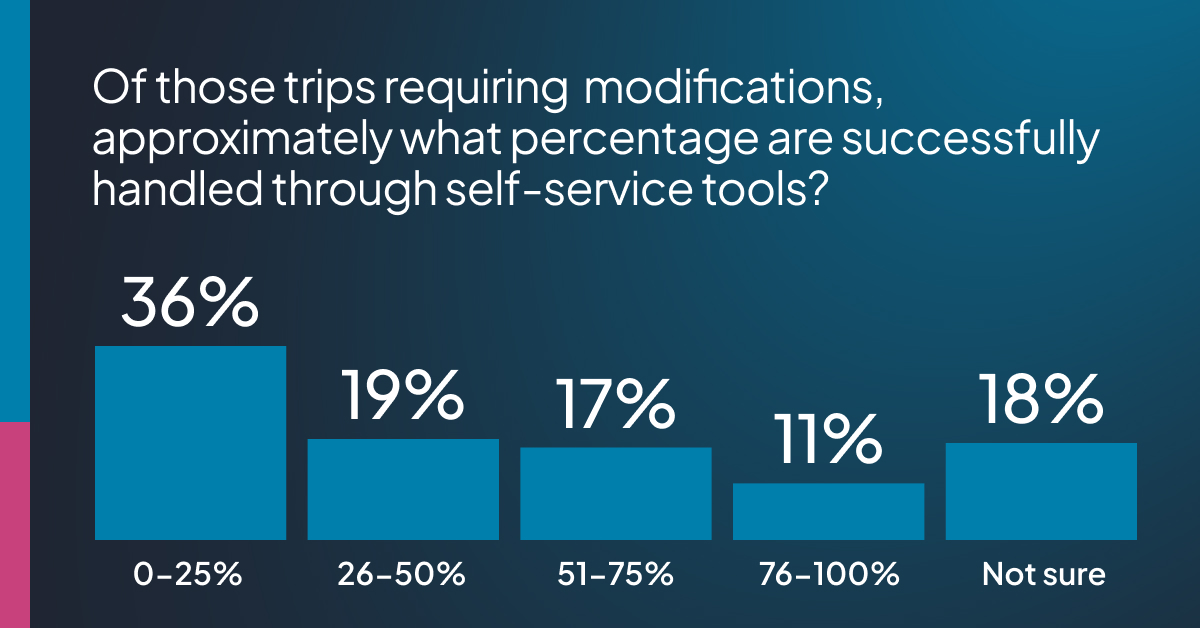
Roughly 9 in 10 respondents said at least 10% of trips require some type of modification after booking. Yet the ability to complete those changes through self-service remains limited. Only 11% said more than three-quarters of trip modifications are successfully handled through self-service tools.
That gap can turn what should be a simple adjustment into a support request.
A traveler may need to move a flight, extend a hotel stay, add a rental car, or cancel one part of an itinerary. If the booking tool cannot handle the request clearly, the traveler has to find another path. That might mean calling an advisor, contacting a supplier directly, or looking elsewhere for an option that appears easier or faster.
For travel managers, the effect extends beyond traveler inconvenience. Every change that leaves self-service creates additional work and gives travelers another reason to move outside the preferred booking process.
Better self-service should make modification a focused task rather than forcing travelers to repeat the original booking process. Travelers need to see what can be changed, understand the implications, and know where to turn when the request becomes too complex to handle alone.
The goal is to make routine changes easier to complete while preserving human support for the situations that require judgment, coordination, or escalation.
2. Travelers need the most support when disruption hits
A booking tool operates under very different conditions when a traveler is sitting at an airport after a cancellation than when that traveler is planning a trip from the office.
The research shows a pronounced gap during these higher-pressure moments. Only 10% of respondents said their current tools support travelers “very effectively” during unplanned disruptions.
Travel managers pointed to recurring problems such as limited visibility into alternatives, lack of real-time rebooking, and the need to contact multiple providers to resolve an issue.
That fragmentation can be especially costly during a disruption because the traveler’s objective has changed. They are no longer comparing options for a future trip. They need a workable answer now.
A canceled flight, for example, may require more than finding another seat. The alternative could affect the traveler’s hotel, car reservation, meeting schedule, and other parts of the itinerary. If each piece has to be handled separately, the traveler or travel team becomes responsible for coordinating the recovery.
This is also a critical moment for the managed travel program. When travelers cannot get an answer through the approved path, they have a strong incentive to find one somewhere else. That can weaken visibility and make it harder for travel teams to know where employees are and what has changed.
Booking technology should therefore be evaluated partly on how well it handles the moments when the original booking no longer works. Real-time alternatives, clear rebooking paths, and access to knowledgeable human support can be just as important as the initial search experience.
3. Travelers experience one connected trip, but booking tools treat transactions separately
Air, hotel, and car reservations may be separate transactions behind the scenes. To the traveler, they are pieces of the same business trip.
That distinction becomes important when something changes.
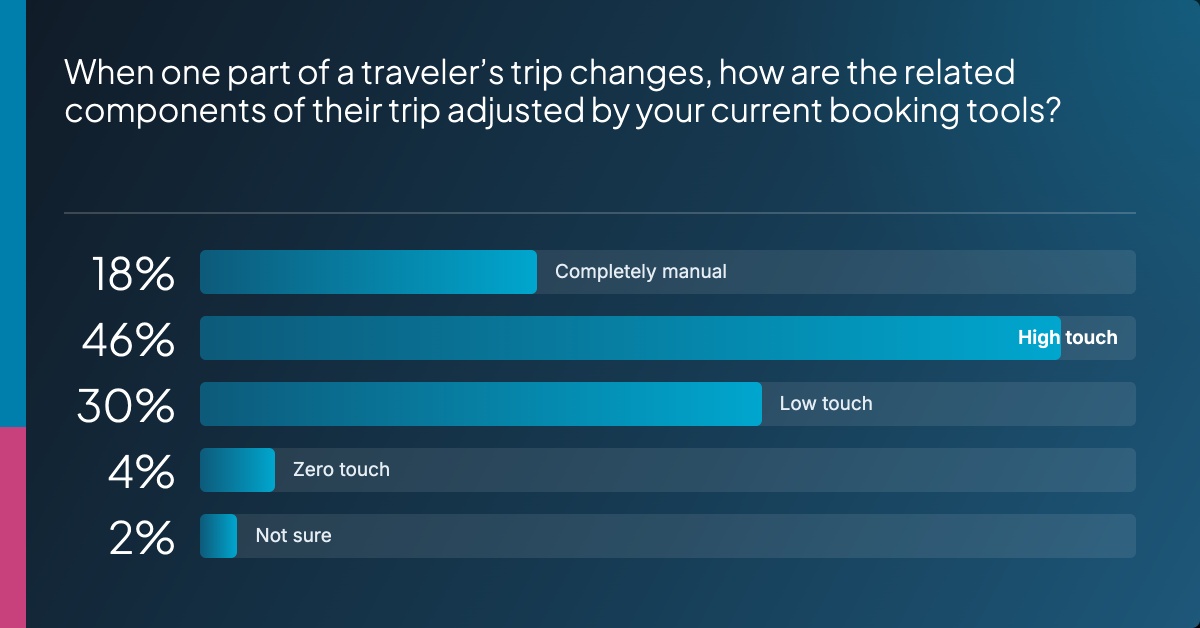
When one part of a trip is modified, 64% of respondents said related trip components are adjusted manually or with high-touch effort. A flight change can therefore create follow-up work across the rest of the itinerary rather than triggering a coordinated response.
This transaction-by-transaction structure places the burden of connecting the trip on travelers, arrangers, advisors, or travel teams.
A more useful model starts with the trip itself. If a flight change affects the hotel arrival or car pickup, the traveler should be able to see those implications without piecing the itinerary back together manually. If an advisor needs to step in, that person should already have the relevant trip context.
For travel managers, a more connected approach also helps preserve policy visibility and program oversight as the itinerary changes.
That is an important shift in how organizations evaluate corporate travel technology. Search quality, content, and ease of booking still count. But the booking experience also needs to be judged by what happens after confirmation.
What an integrated booking model looks like
The research points toward a broader way of thinking about booking technology.
Travel managers should ask whether travelers can change an existing trip without starting over, whether disruption support is built into the same environment, and whether the rest of the itinerary stays connected when one component changes.
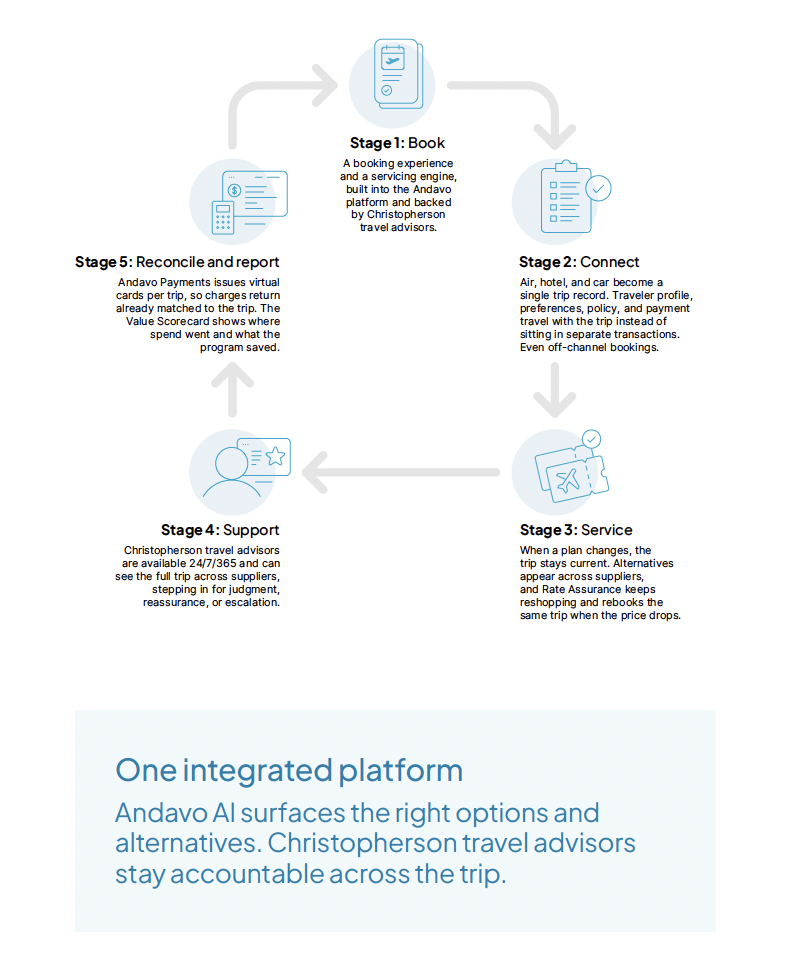
They should also look beyond servicing itself. A truly connected model carries the trip through the full lifecycle: booking, connecting the itinerary, servicing changes, supporting the traveler, and bringing payment and reporting data back into the program.
That is the model Christopherson is building through Andavo Booking and the broader Andavo platform. Air, hotel, and car can live together as a single trip record alongside traveler profile information, preferences, policy, and payment. Off-channel bookings can also be brought into that same view.
When plans change, the same trip record stays in place. Travelers can see alternatives, and Christopherson advisors can step in with the full trip context rather than starting from a disconnected support request. The connection continues after travel as payment, reconciliation, and reporting data remain tied back to the trip.
The model also clarifies where technology and people each fit. Technology can handle routine booking and servicing work, surface relevant options, and carry context forward. Human advisors remain accountable for the moments that require judgment, reassurance, or escalation.
For travel teams, that means evaluating booking as one stage of a larger process rather than as an isolated transaction.
The next test for corporate travel booking
The findings suggest that travel managers should broaden the questions they ask when evaluating booking technology.
Can travelers change an existing trip without restarting the process? What happens when a flight is disrupted? Can the tool account for the rest of the itinerary when one component changes? Can an advisor see the same trip the traveler sees? And does the data continue through payment, reconciliation, and reporting?
Those questions move the focus beyond confirmation and toward the full lifecycle of business travel.
For travel programs, that follow-through may be a better measure of booking performance than the reservation alone.
Download the white paper to see the full research and learn what travel managers should consider when evaluating booking, service, and support across the full trip.



.jpg)