6 ways to find additional business travel savings after booking
The price paid at booking doesn’t always reflect the final cost of business travel. Learn how travel managers can recover unused credits, capture lower rates, and identify overlooked opportunities to reduce travel spending.
November 12, 2026
A hotel rate drops a week after a reservation is confirmed. An employee cancels a trip, leaving hundreds of dollars in unused airline credits. A flight disruption qualifies for a refund, but the traveler accepts a credit instead.
Each situation presents an opportunity to recover money that has already been committed to business travel.
Corporate travel programs invest considerable effort in controlling costs at the time of purchase through negotiated rates, preferred suppliers, and booking policies. Yet airline fares and hotel rates continue to fluctuate, travel plans change, and supplier agreements don’t always deliver the expected savings.
“The purchase isn’t finished once the booking is done,” said Matt Cameron, Chief Consulting Officer at Christopherson.
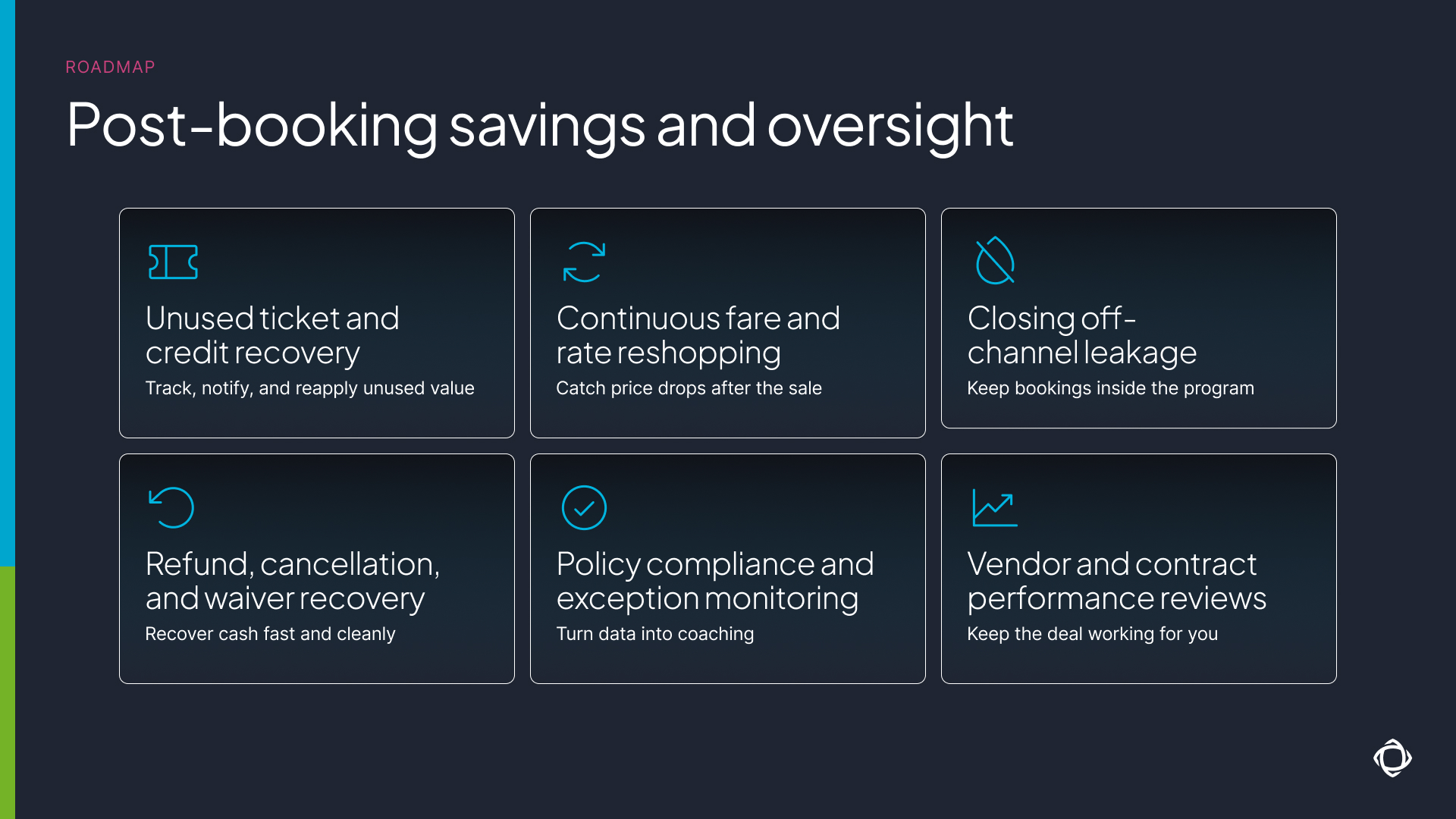
Many corporate trips are booked weeks or months before departure, leaving time to recover credits, pursue refunds, or capture lower rates. Reviewing booking behavior and supplier performance can also reveal opportunities to reduce costs on future trips. Here are six areas where travel managers can find additional savings after booking.
1. Recover unused airline tickets before they expire
Canceled business trips often leave behind airline credits that can be applied toward future travel. Without a reliable tracking process, those credits can expire before the company recovers their value.
Industry estimates cited by Christopherson suggest that unused, unrecovered airline tickets can represent roughly 10% to 11% of annual travel spend when they aren’t actively managed. The amount varies by organization, but even a relatively small percentage can represent substantial money for companies with frequent travelers.
One common problem is the partial use of airline tickets. For example, when a traveler completes one portion of an itinerary but cancels another, the remaining ticket may retain some value under the airline’s rules.
“A lot of times, partial tickets get lost in the shuffle, but they still do retain value,” said Paul Foster, a strategic consultant at Christopherson.
Recovering that value starts with a complete inventory of unused tickets, including partially used credits. Travel managers should have visibility into who owns each credit, its remaining value, applicable airline restrictions, and expiration date.
An effective unused ticket management process should include:
Automated tracking: Maintain an accurate inventory of unused and partially used airline tickets across the travel program.
Expiration reminders: Notify travelers and managers at intervals such as 120, 60, and 30 days before credits expire.
Credit application: Identify eligible credits during future bookings and establish a process for applying them.
Transferability reviews: Determine whether credits assigned to former employees or infrequent travelers can be reassigned when airline rules permit.
Regular reporting: Give travel managers and department leaders visibility into outstanding credits and upcoming expiration dates.
Airline ticket validity, exchange rules, and transferability vary by carrier and fare type, making it important to understand the conditions attached to each credit.
Christopherson provides unused ticket reporting through its Andavo technology, giving travel managers information they can use to monitor outstanding balances. Advisors can also identify applicable credits during the booking process.
For organizations with decentralized travel management, sharing unused ticket reports with department managers can help distribute responsibility and reduce the administrative burden on a central travel team.
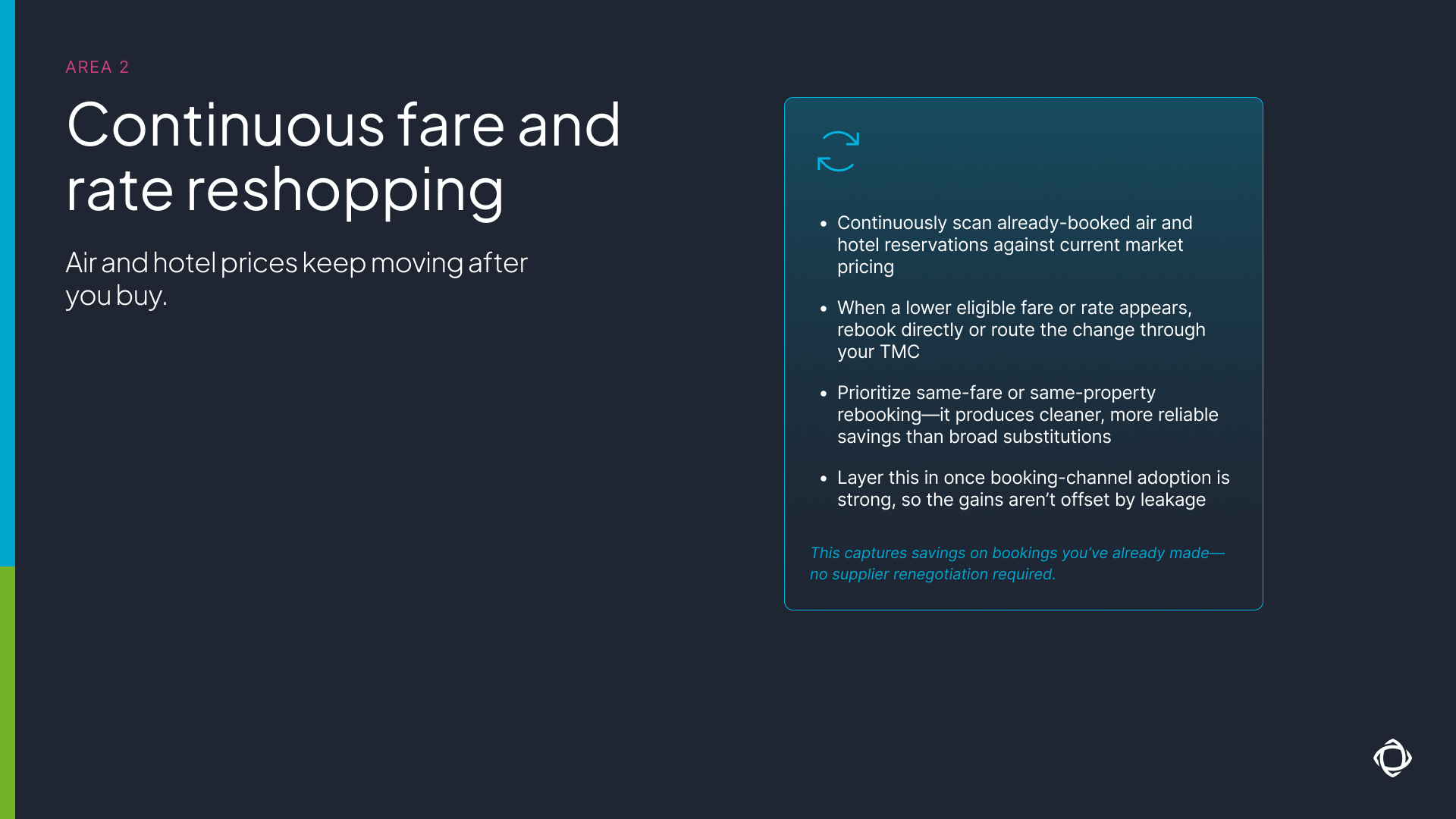
2. Capture lower airfares and hotel rates after booking
Airline and hotel pricing changes constantly in response to demand, availability, and market conditions. A rate that was competitive when booked may no longer be the lowest available price several days later.
Hotel reservations are particularly well suited to post-booking rate monitoring because prices often fluctuate between the original reservation date and check-in.
Industry figures referenced by Christopherson indicate that approximately 39% of monitored hotel reservations show a lower rate after booking. The potential savings depend on how much the price drops and whether the original reservation can be changed without penalties.
Continuous rate re-shopping tools monitor existing reservations and identify opportunities to rebook at a lower price. The most practical programs prioritize like-for-like comparisons, preserving the traveler’s original arrangements.
For hotel reservations, that means maintaining the same property, room type, amenities, and applicable booking conditions. Airline re-shopping follows a similar principle, comparing the same flight and cabin rather than changing the itinerary to capture a lower fare.
As Cameron explained, the purpose is straightforward: “It’s just to pick up the money, not change the experience.”
This approach helps preserve traveler preferences while limiting the disruption that can come with changing reservations. Automated systems should also account for hotel cancellation deadlines and airline ticketing restrictions before making changes.
Christopherson’s Rate Assurance service monitors eligible reservations for lower prices. According to Cameron, approximately 7% of monitored hotel reservations are rebooked at lower rates that exceed the program’s $20 savings threshold.
As of October 2026, Rate Assurance had generated approximately $1.5 million in cumulative savings for participating Christopherson clients, according to Cameron.
The potential can be considerable on individual trips. Foster described a hotel reservation where re-shopping identified a rate decrease of nearly $100 per night after the original booking.
Travel managers evaluating continuous re-shopping should consider the reservations eligible for monitoring, minimum savings thresholds, potential rebooking fees, and any reconciliation requirements. The net savings should justify the additional transaction activity.
3. Pursue refunds and airline waivers when travel plans change
Flight cancellations and schedule disruptions create another opportunity to recover travel spending.
When an airline cancels a flight or makes certain significant schedule changes, passengers may qualify for a refund rather than an airline credit, depending on the circumstances and applicable rules.
Travelers who don’t understand their options may accept a credit when a refund is available. That decision can leave company funds tied to future travel and introduce the risk of the credit expiring unused.
Airline waivers also deserve attention. During severe weather, operational disruptions, and other qualifying events, airlines may temporarily relax their normal cancellation or exchange rules.
These waivers often have specific eligibility requirements and deadlines. Missing the applicable window can mean paying fees or losing access to more favorable terms.
Travel managers can improve recovery by establishing procedures for handling airline-initiated changes and cancellations.
That includes distinguishing between voluntary traveler changes and airline-initiated disruptions, monitoring applicable waiver policies, and keeping cancellation documentation accessible to the travel management team.
Corporate travel policies should also tell employees what to do when an airline cancels or significantly changes a flight. Rather than immediately accepting a credit or making alternative arrangements independently, travelers should know when to contact their travel management company to review available options.
A consistent process helps travel teams identify eligible refunds promptly and avoid losing money through missed deadlines.
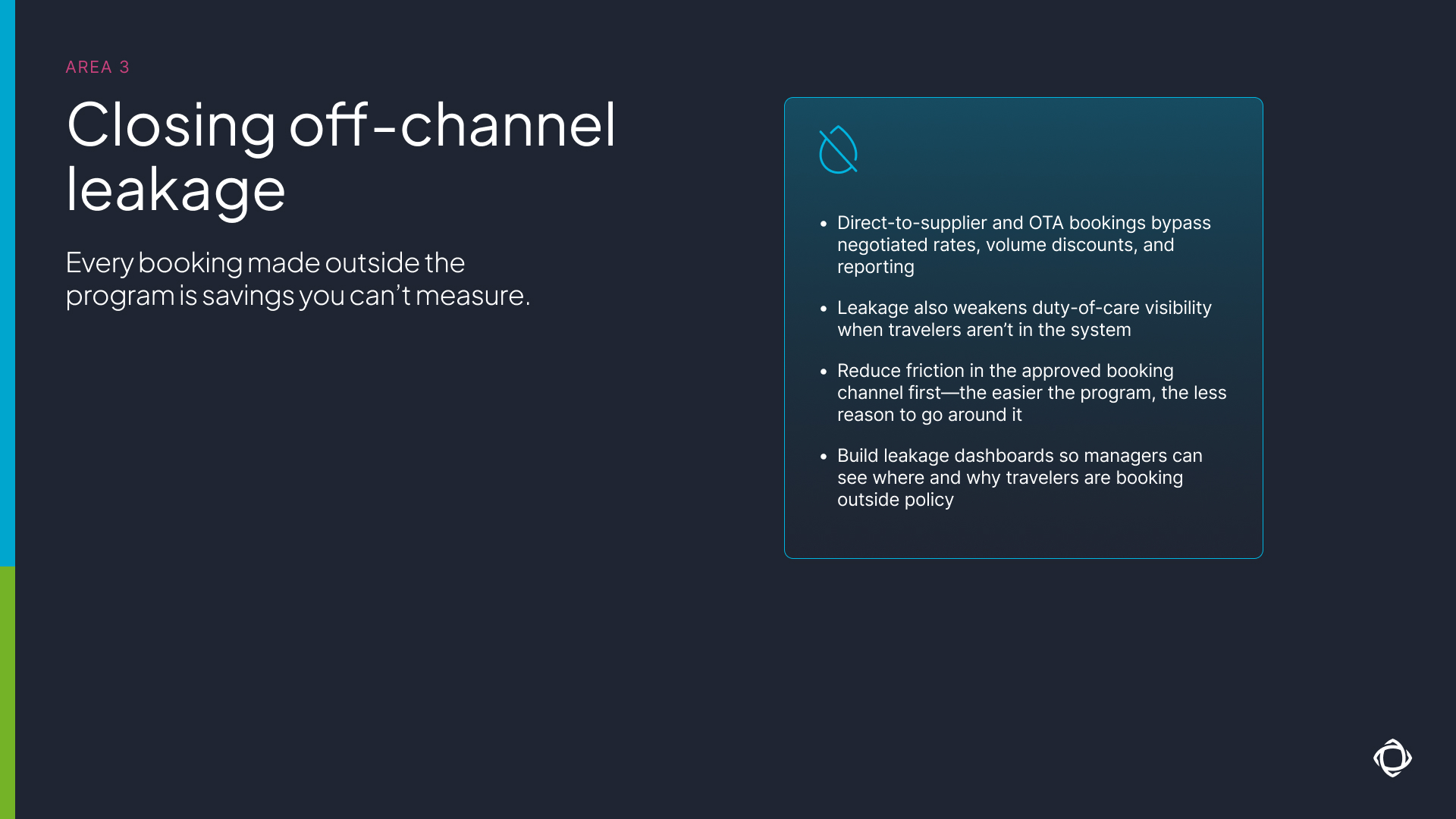
4. Reduce off-channel bookings that limit savings opportunities
Post-booking savings programs depend on visibility into the reservations they monitor. When travelers book outside approved channels, those reservations may never enter the process.
Known as travel program leakage, this occurs when employees purchase travel directly from suppliers or online travel agencies instead of using the company’s approved booking channels.
Consider an employee who books airfare through the corporate travel management company but reserves a hotel directly through the property’s website.
That hotel booking may fall outside the company’s negotiated rate program and continuous re-shopping process. It may also be missing from centralized reporting, making it harder to measure supplier performance and identify savings.
Leakage creates a separate concern for duty of care. Without the hotel reservation in the managed itinerary, the travel team may know the employee’s flight destination but lack details about where the traveler is staying during a disruption or emergency.
Reducing leakage begins with understanding its scale. Travel managers can compare expense data against reservations processed through their travel management company, separating expenses such as meals and local ground transportation that may fall outside the normal booking process.
The resulting gaps can help identify which travelers, departments, or suppliers account for the most off-channel spending.
Understanding why travelers book elsewhere is equally important. Some may believe they can find better prices directly. Others may have trouble locating preferred options or completing reservations through the approved system.
Cameron recommends making the approved booking channel as easy to use as possible. Clear policies, competitive content, and accessible traveler support can help improve adoption without creating unnecessary approval requirements.
As more reservations move through approved channels, organizations can capture more of the savings available through negotiated agreements, unused ticket recovery, and automated re-shopping.
5. Use policy exception reporting to identify recurring costs
Corporate travel policies establish expectations for booking behavior, but actual travel patterns don’t always follow those rules.
Employees may book outside preferred suppliers, purchase tickets too close to departure, or select travel options that exceed policy limits. While some exceptions are unavoidable, recurring patterns can reveal unnecessary costs or weaknesses in the policy itself.
Exception reporting helps travel managers understand where travelers deviate from policy and why.
Standardized exception reason codes are particularly useful. Instead of allowing dozens of overlapping explanations, organizations can use a smaller set of clearly defined reasons that make trends easier to compare over time.
For example, repeated exceptions involving advance-purchase requirements might indicate that employees need better booking guidance. They could also reflect legitimate business requirements that the existing policy doesn’t adequately address.
Similarly, low usage of preferred suppliers may point to availability problems, unfavorable contract terms, or a lack of traveler awareness.
Reviewing exceptions monthly helps travel managers determine whether recurring problems call for employee training, supplier adjustments, or policy changes. A broader policy review every six to 12 months can help ensure that requirements still reflect the organization's travel needs.
6. Review supplier contracts against actual travel patterns
Negotiated airline, hotel, and car rental agreements can lose some of their value as an organization’s travel needs change.
A company may establish preferred relationships based on destinations and travel volumes that no longer reflect current business activity. Departments expand, project locations shift, and employees begin traveling to different markets.
Without regular reviews, companies may continue directing spend toward supplier agreements that deliver fewer benefits than originally expected.
Foster warned that working with too many preferred suppliers can dilute the volume companies need to negotiate favorable terms.
For example, spreading car rental spending across four preferred suppliers may reduce the negotiating strength that could come from concentrating more volume with fewer providers.
Travel managers should periodically compare contracted supplier agreements against actual booking activity, including market coverage, usage rates, and negotiated discounts.
Car rental programs deserve particular scrutiny. A negotiated daily rate may appear favorable, but added fees or rates that differ from the agreement can reduce the expected savings.
Regular audits can help identify discrepancies and provide an opportunity to address them with the supplier.
A useful supplier performance review should assess whether:
Preferred suppliers still serve the company’s most frequently traveled destinations.
Negotiated rates and contract terms are consistently available and applied.
Actual booking volumes support the organization’s negotiated agreements.
Additional fees are reducing the expected value of contracted rates.
Consolidating or revising supplier relationships could improve future agreements.
Quarterly supplier performance discussions, supported by a more detailed contract review every six to 12 months, can help organizations respond to changing travel patterns before agreements come up for renewal.
Build a regular process for monitoring post-booking savings
The six opportunities above require different levels of attention. Some, such as automated rate re-shopping, can operate continuously. Others depend on periodic reviews or quick decisions when a disruption occurs.
Without clear ownership, even well-designed savings programs can fall short.
“The key point is to make sure somebody has ownership," Cameron said. Otherwise, opportunities to recover savings can disappear between booking and travel.
Organizations can assign that responsibility to a centralized travel team or distribute certain tasks among department managers. Either approach can work when the people responsible have access to the right information and understand what actions to take.
A practical monitoring schedule might look like this:
Automation can reduce much of the manual work involved. But reporting still needs to reach the people who can act on it.
Travel managers should work with their travel management company to establish appropriate alerts, scheduled reports, and access for department leaders when necessary.
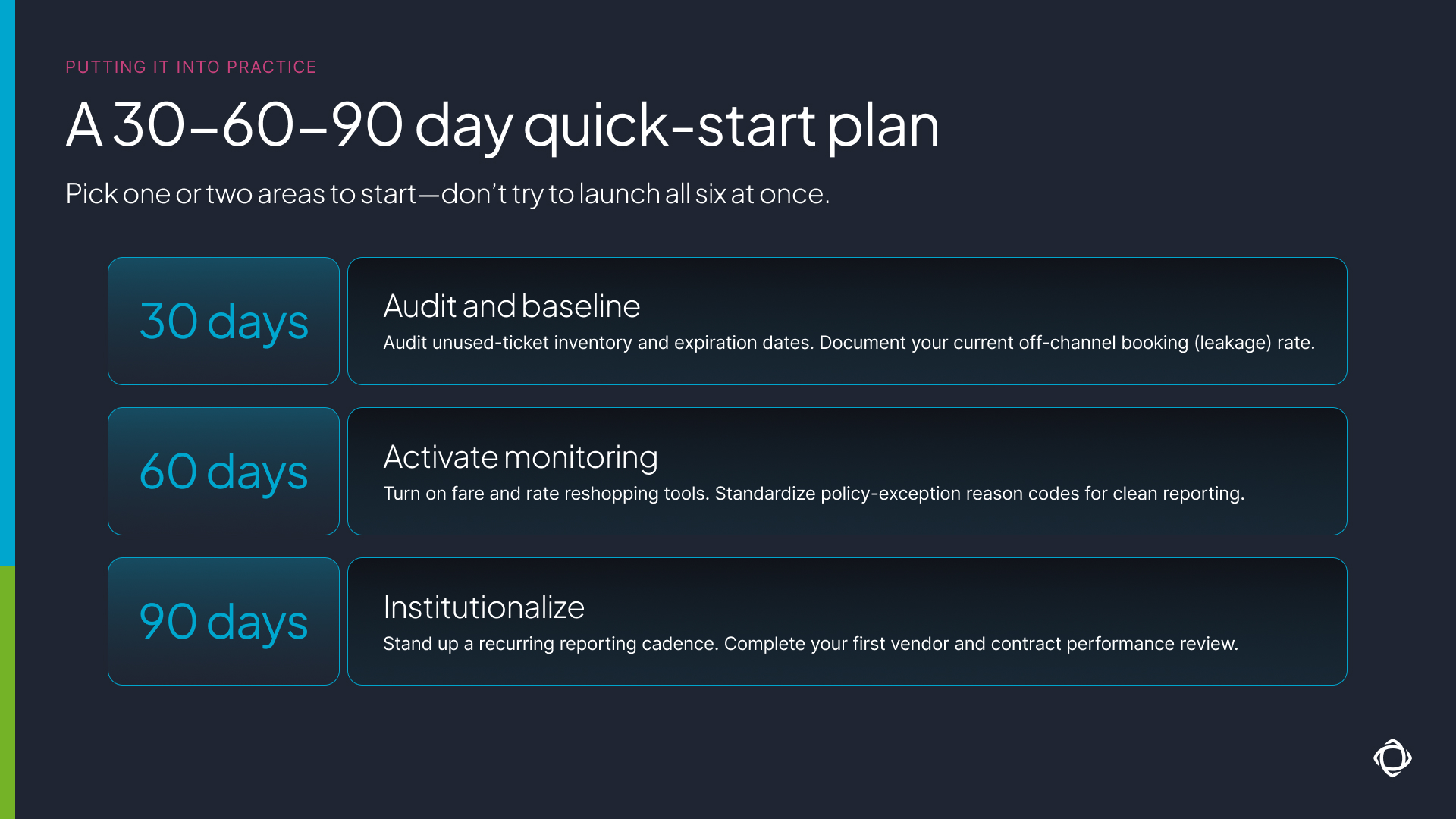
A 90-day plan to get started
Organizations looking to improve post-booking cost control can begin with a focused review rather than introducing every process at once.
First 30 days: Establish a baseline. Audit unused airline tickets, identify credits approaching expiration, and compare expense data with managed booking records to estimate travel program leakage. These findings will help reveal the most immediate recovery opportunities.
By day 60: Activate monitoring. Review available fare and hotel re-shopping tools, establish reporting for policy exceptions, and standardize exception reason codes. Assign responsibility for reviewing alerts and recovering eligible credits.
By day 90: Establish a regular review schedule. Begin recurring savings reviews, assess preferred supplier performance, and document how the travel team will measure progress. Use early findings to determine which areas deserve additional attention.
The goal is to make post-booking cost control a routine part of travel program management, supported by reliable data and clear accountability.
Make post-booking savings part of your travel management strategy
For travel managers looking for a starting point, unused ticket recovery and booking leakage offer two practical areas to investigate. Both can reveal money already committed to travel that may be recovered or better managed.
Christopherson helps organizations build on these findings through unused ticket management, Rate Assurance, policy compliance and exception monitoring, vendor performance reviews, and channel leakage support. With ongoing monitoring and support, travel teams can identify savings opportunities before they disappear and use the findings to improve future spending decisions.