Beyond duty of care: What business travelers expect from safety programs
New BCD survey data shows that while many employers are expanding duty-of-care efforts, travelers still experience major gaps in communication, real-time visibility, and how individual risk factors are recognized and supported.
February 26, 2026
As global business travel grows more complex, safety expectations are evolving just as quickly. Geopolitical instability, extreme weather events, infrastructure disruptions, and social unrest have made risk a daily reality, not an exception.
But according to new survey data from BCD Travel Research & Intelligence, the issue isn’t simply whether companies have safety programs in place. It’s whether travelers can see them, understand them, and trust them when it matters most.
Based on responses from 1,284 business travelers worldwide, the findings reveal a clear theme: modern duty of care must be visible, personalized, and responsive in real time.
Travelers say communication is the biggest safety gap
When asked where employers should improve safety measures, travelers didn’t call for sweeping new programs. Instead, they pointed to clarity.
Clearer communication or guidance ranked as one of the most common areas for improvement, alongside safer hotels and transportation options. One in five travelers also called for better tools and improved crisis response protocols. Notably, only about one-quarter said no improvements were needed.
The takeaway is straightforward: many companies have safety frameworks in place, but travelers want clearer direction and better visibility into how those measures apply to them.
“Organizations are investing in safety,” said Dallas Stewart, client consulting services manager at Christopherson. “But if travelers don’t understand what’s available or how to use it, those investments don’t translate into confidence.”
Many travelers see progress, but a third aren’t sure
Encouragingly, more than half of travelers (56%) believe their employer’s safety measures are evolving to address new and emerging risks. However, 35% say they’re not sure, and 9% believe their company is not responding adequately.
That uncertainty is significant. It suggests safety strategies may be expanding internally, but communication isn’t keeping pace.
“Perception matters,” Stewart explained. “If travelers aren’t sure whether their company is adapting to new risks, that uncertainty becomes a risk in itself.”
This communication gap reinforces the growing importance of real-time visibility tools. When travel managers can quickly see where travelers are and what’s happening around them, and when travelers know that visibility exists, safety shifts from theoretical to tangible.
Real-time visibility is becoming the new baseline
One way organizations are closing this visibility gap is through live travel intelligence tools. Christopherson’s new Andavo travel platform features a smart traveler map that provides a centralized, real-time view of traveler locations, flight disruptions, and risk alerts in one interface.
Rather than relying on delayed reports or static spreadsheets, travel and security teams can filter by location, risk level, or trip details to instantly identify who may be impacted by a developing situation.
“When something changes, seconds matter,” said Stewart. “Being able to see exactly who’s where, and what’s happening with their trip, allows companies to respond quickly and precisely.”
Complementing that view is Andavo’s complete trip breakdown, which delivers a consolidated table of every traveler and trip across the organization. Customizable views and exportable data make it easier to move from high-level oversight to individual traveler support—especially during disruptions.
"I am loving the new Andavo Admin app,” said Denise Daniel, senior global travel manager at Domo. “The notifications letting me know when my travelers are experiencing disruption have been key in helping me to proactively reach out and provide real-time duty of care. I also appreciate the ability to keep an eye on traveler’s locations so that I have those security features right in the palm of my hand.”
Together, these tools reflect a broader industry shift: safety programs must move beyond policy documents and into actionable intelligence.
The personal risk conversation is still missing
Beyond general safety measures, the survey data highlights another challenge: personalization.
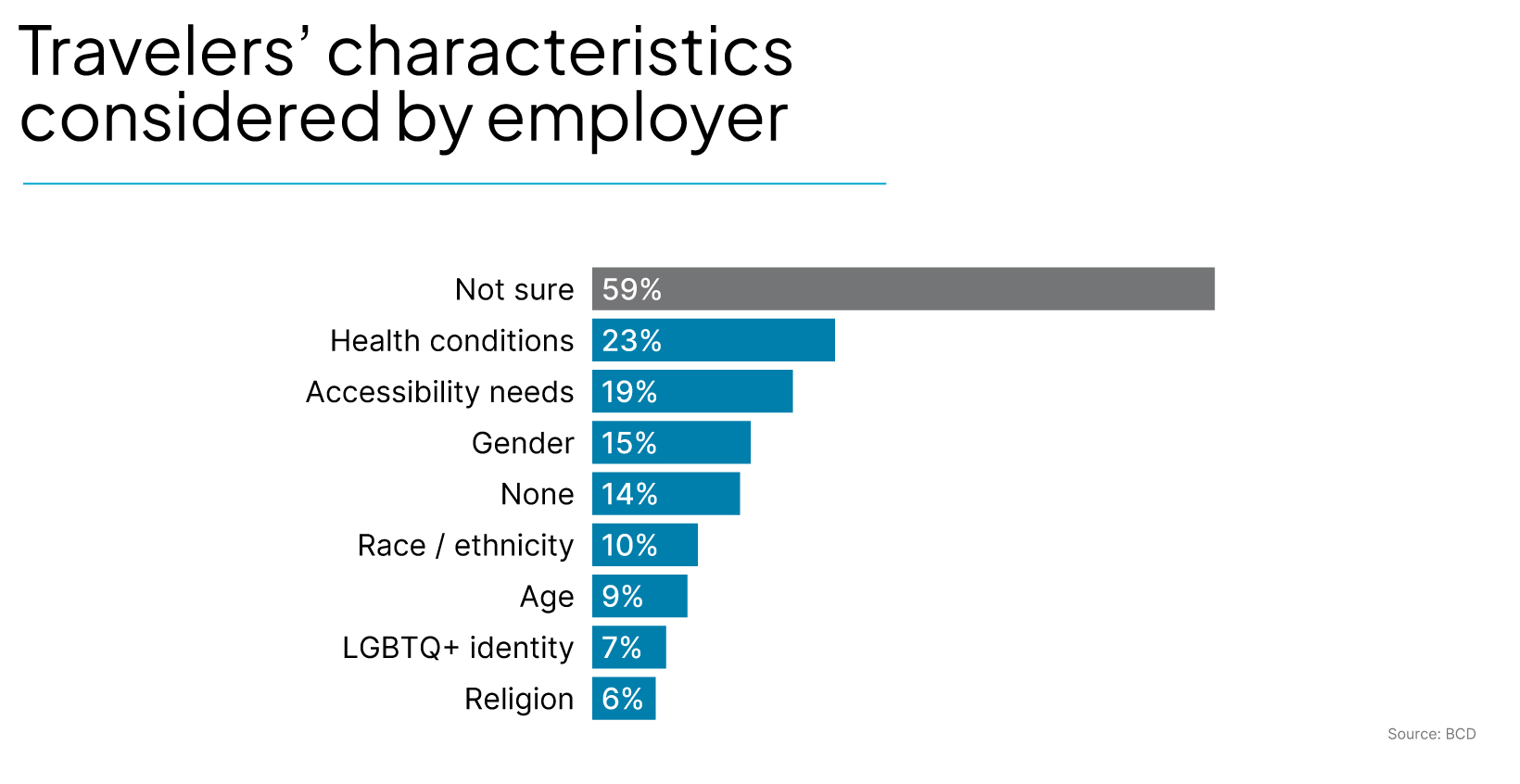
Six in ten travelers said they are unsure which personal characteristics their employer considers when assessing travel risk.
Among those who are aware, health conditions and accessibility needs are the most commonly considered factors, followed by gender. But characteristics such as age, religion, cultural background, and LGBTQ+ identity appear far less frequently.
That lack of transparency signals an opportunity for improvement.
“Travelers don’t expect a one-size-fits-all safety program,” said Stewart. “They want to know their individual circumstances are recognized and accounted for.”
What travelers expect employers to consider
When asked what should be considered in risk planning, expectations were markedly higher across nearly every category.
More than half of respondents believe health conditions should be prioritized. Nearly half cited disability or accessibility needs. Gender, age, religion or cultural background, race or ethnicity, and LGBTQ+ identity all ranked significantly higher than current perceived practices.
The contrast is clear: travelers’ expectations exceed what they believe employers currently address. When personalization becomes operational—not theoretical—organizations are better positioned to close this expectation gap.
Safety resources are common, but not consistent
The survey also reveals uneven access to safety resources across organizations.
Nearly seven in ten travelers report having flexible travel options, 24/7 emergency support, and travel risk alerts during their trips. Yet fewer than half have access to mental health resources, emergency update apps, or formal reporting processes for safety concerns.
Identity-based travel guidance and periodic safety check-ins rank among the least common offerings—despite growing awareness of individual risk factors.
Availability alone, however, doesn’t guarantee awareness.
Mobile safety access isn’t universal
Two-thirds of travelers say they can access safety information through their booking app, and nearly one-third use a dedicated risk provider app. Still, 8% report having no mobile access to safety information, and 11% are unsure whether they do.
That uncertainty again reinforces the central theme: visibility is just as important as infrastructure.
Centralized platforms that unify booking data, traveler locations, and real-time risk intelligence reduce fragmentation and make safety information easier to access when it’s needed most.
From compliance to confidence
Taken together, the findings suggest the future of duty of care is less about adding more policies and more about improving how information flows.
Travelers want to know their employer can see what’s happening, understand who may be affected, and is prepared to act quickly when conditions change.
Daniels noted that beyond the operational benefits, ongoing innovation matters just as much.
“It’s really meaningful to me that Christopherson keeps innovating and improving their technology to meet the needs of my growing travel program,” she said.
That expectation for continuous improvement reflects a broader shift in managed travel. Technology alone is no longer enough. Visibility must be immediate, communication must be clear, and support must feel personal.
“For travelers, safety is ultimately about trust,” said Stewart. “When they know their company has real-time visibility and a clear response plan, it fundamentally changes how secure they feel on the road.”