6 trends in rental cars, ride-hailing, and autonomous vehicles travel managers can’t ignore
From improving ride-hail satisfaction to the quiet advance of autonomous vehicles, the latest research points to a ground transportation sector regaining traveler trust while preparing for long-term disruption.
June 9, 2026
Ground transportation is becoming easier to trust again, but harder to manage on autopilot. According to Business Travel News’ 2026 Car Rental Survey, buyer sentiment across rental cars, ride-hailing, and chauffeured services is improving as autonomous vehicles begin to surface in managed travel programs.
For travel managers, the shift creates a useful opening. Stronger service levels make this a good time to revisit supplier performance, traveler satisfaction, policy fit, and reporting. New vehicle technology also raises new questions around safety, reimbursement, duty of care, and program visibility.
Here are six ground transportation trends travel managers should watch as they evaluate suppliers, update policy, and prepare travelers for what may come next.
1. Service levels are improving across ride-hail and chauffeured segments
One of the clearest takeaways from BTN’s survey data is the improvement in buyer ratings for both ride-hailing and chauffeured transportation providers. After years of driver shortages, pricing inconsistency, and service gaps, buyers are reporting stronger performance across several categories.
BTN describes the improvement as broad-based, with gains across key service metrics. For chauffeured transportation providers, buyers rated drivers and company employees at 4.43 out of 5, clean and well-serviced vehicles at 4.29, complaint and problem resolution at 4.22, and availability and ease of booking at 4.20.
Those results are especially relevant for corporate programs that rely on chauffeured transportation for executives, client visits, events, high-value meetings, or security needs. When service quality improves in this category, travel managers have more room to focus on consistency, reporting, and traveler confidence rather than basic reliability.
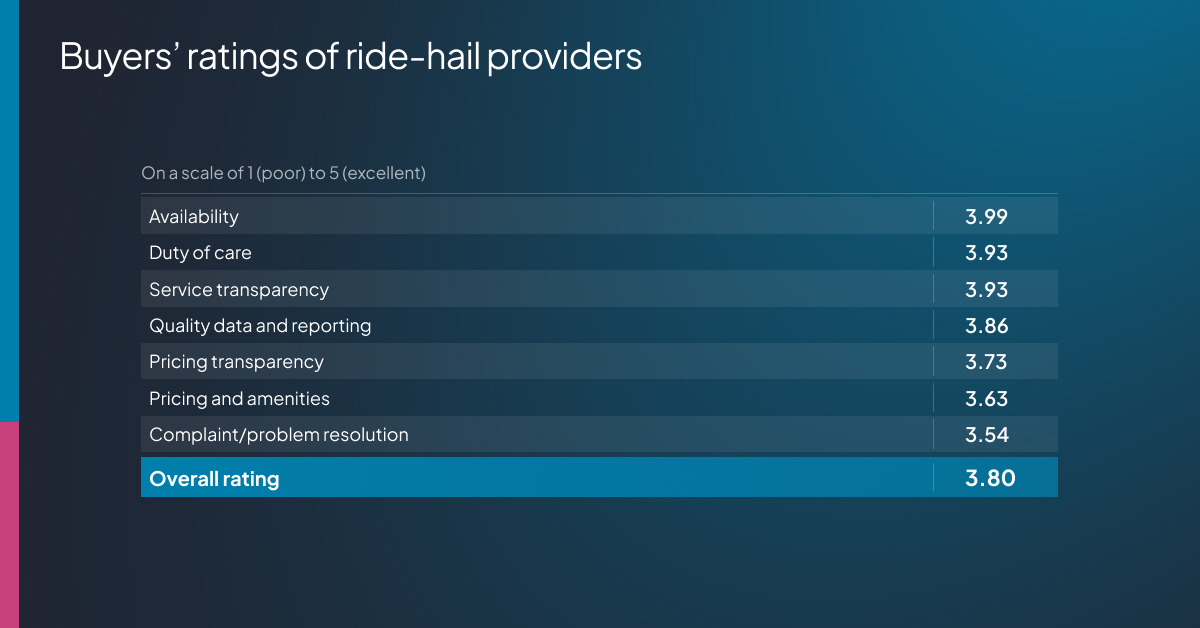
Ride-hailing also showed strength in practical program areas. Buyers gave ride-hail providers their highest marks for availability at 3.99, duty of care at 3.93, service transparency at 3.93, and quality data and reporting at 3.86.
The two charts work together: chauffeured providers received stronger overall ratings, while ride-hail providers continued to perform well in areas tied to everyday access and visibility. For travel managers, that distinction can help guide when each option makes the most sense.
“Ground transportation decisions should be based on the trip, the timing, distance, and parking requirements,” said Carol Del Giudice, an account executive at Christopherson. “A quick ride across town and a high-profile executive transfer may both fall under ground transportation, but they carry different expectations.”
2. Corporate buyers are regaining confidence, but they remain watchful
The improvement in service ratings gives buyers more confidence, but it does not erase the lessons of the past few years. Travel managers still remember the pricing swings, inconsistent availability, and service gaps that affected corporate ground transportation after the pandemic.
That history has changed how many programs evaluate suppliers. Cost is still important, but buyers are also looking at reliability, traveler experience, service recovery, data quality, and duty of care.
“Ground transportation used to sit in the background of a travel program,” said [Christopherson expert]. “Now it affects visibility, safety, traveler satisfaction, and the company’s ability to understand what actually happened during the trip.”
For many companies, this is a good time to review whether current suppliers still fit the program. Travel managers can look at which modes travelers use most often, where service complaints appear, and whether the supplier mix supports different traveler groups and trip types.
3. Rental cars remain foundational, but the conversation is changing
Although ride-hailing and chauffeured services are showing strong gains, rental cars continue to play an important role in corporate travel programs. They remain especially useful for trips that require flexibility, multi-stop travel, suburban or rural access, or transportation beyond major metro areas. Add
The next question is how soon autonomous vehicles will affect corporate programs.
BTN’s autonomous vehicle coverage suggests AVs are moving toward managed travel in ways that may not be immediately visible to buyers. The shift is unlikely to arrive all at once. It may show up first through supplier pilots, fleet partnerships, or technology integrations behind familiar booking and transportation models.
“Rental cars still solve needs that ride-hail can’t always cover,” said Del Giudice. “For some trips, it’s not just about moving people. It may be about moving equipment, needing a larger vehicle, or reducing wear and cost compared with using a personal or company vehicle.”
4. Autonomous vehicles are emerging incrementally
BTN’s research shows that autonomous vehicles are beginning to enter corporate ground transportation, even though most managed travel programs are not treating them as a standard option yet.
The policy gap is clear.
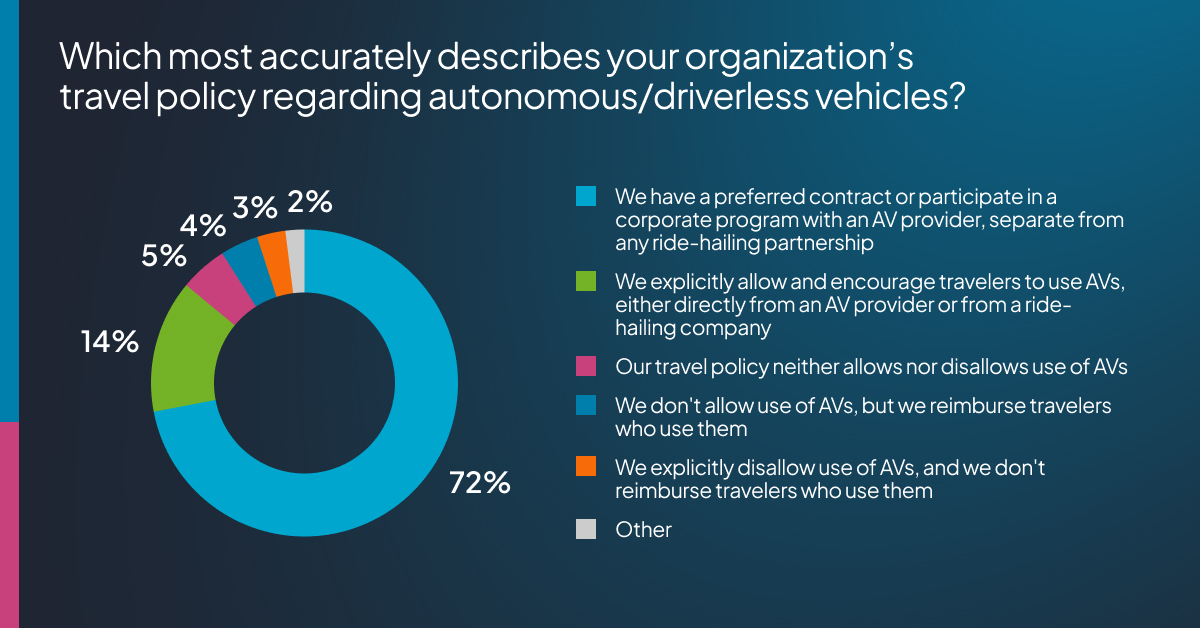
BTN’s survey found that 72% of organizations have a travel policy that neither allows nor disallows the use of autonomous or driverless vehicles. Another 14% explicitly allow and encourage travelers to use AVs, while smaller shares either disallow AV use, reimburse travelers who use them despite restrictions, or have another policy approach.
That 72% figure matters because many travel programs could face real-world traveler questions before they have formal guidance in place.
“The risk is that a traveler uses an AV before the company has decided how it should be approved, reimbursed, or supported,” said Del Giudice.
Travel managers don’t need to rewrite the entire ground transportation policy today. They can start by asking focused questions:
Are any preferred suppliers testing AVs in markets where employees travel?
Would travelers know if an AV was part of their trip?
How would AV use appear in expense reporting?
Would the company reimburse an AV ride booked through a ride-hailing app?
What safety, insurance, and duty-of-care standards would apply?
Who supports the traveler if an AV trip is delayed or disrupted?
These questions give travel teams a starting point. They also help procurement, risk, legal, HR, and finance teams prepare before AV usage becomes more common.
5. Better service gives buyers room to ask sharper questions
Stronger service ratings give travel managers a chance to move supplier conversations past basic recovery. Instead of asking only whether providers can deliver consistent availability and problem resolution, buyers can ask how those standards will be maintained.
For chauffeured transportation, that may include service consistency across affiliates, executive traveler support, duty-of-care procedures, and complaint resolution. For ride-hailing, buyers may want to focus on safety protocols, pricing transparency, traveler visibility, and the quality of reporting data.
The emergence of AVs adds another layer. Travel managers should ask suppliers whether they are testing autonomous vehicles, where those pilots are happening, and how corporate travelers would be notified or supported if AVs became part of the service. Companies with international travel programs may also want to understand how AV regulations, liability requirements, and supplier policies differ across countries and regions.
Ground transportation buyers have an opportunity to turn improved service levels into clearer expectations around visibility, safety, reporting, traveler support, and compliance.
6. Ground transportation is becoming more connected
A recurring theme across BTN’s ground transportation research is that rental cars, ride-hailing, and chauffeured services are increasingly part of the same mobility strategy.
A single business trip may include a rental car at the airport, a ride-hail trip to dinner, and chauffeured transportation for a client meeting. Travel managers need enough visibility to understand how those choices affect cost, traveler experience, safety, and policy compliance.
Ground transportation also touches expense management, duty of care, supplier sourcing, traveler communication, and reporting. That makes it harder to manage as a disconnected afterthought.
“The best ground transportation strategy gives travelers practical options without leaving the company blind,” said Del Giudice. “Visibility matters because travel managers can’t manage what they can’t see.”
What travel managers should do next
BTN’s 2026 findings point to a ground transportation category that is improving but still changing. Stronger buyer ratings give travel managers a reason to revisit supplier performance, while AVs add new questions around policy, reimbursement, and traveler support.
Travel managers can start by reviewing:
Ground transportation usage by mode, market, and traveler group
Visibility into ride-hail, chauffeured, and rental car activity
Supplier processes for service recovery, safety, reporting, and duty of care
AV policy language before traveler behavior gets ahead of company guidance
Ground transportation may not receive the same attention as air or hotel, but it can shape the success of the trip. A missed pickup, unclear reimbursement rule, poor data trail, or unsupported disruption can affect meetings, traveler confidence, and program visibility.
Companies that manage this category well will treat it as part of the larger travel program, connected to cost control, policy, reporting, traveler experience, and duty of care.